When rounds accumulate, the industry appears
A single survey is a photograph. Surveys accumulate into a company's timeline; companies in the same sector accumulate into a position on the distribution. Possible only because every survey is measured against the same standard.

A year later we re-ran the same survey, and the scores went up. But last year and this year were grading the same responses differently. Which meant we had never once measured against the same yardstick. It was why the reaction in the meeting room felt strange.
While we were building OpenKnock Culture Ladder, there was one promise we had to pin down before anything else. The yardstick must not change between one survey and the next. If Culture Ladder breaks its own promise between rounds, the time we measured with it becomes a lie on the spot.
01 · Same Yardstick
The yardstick stays; only the questions change
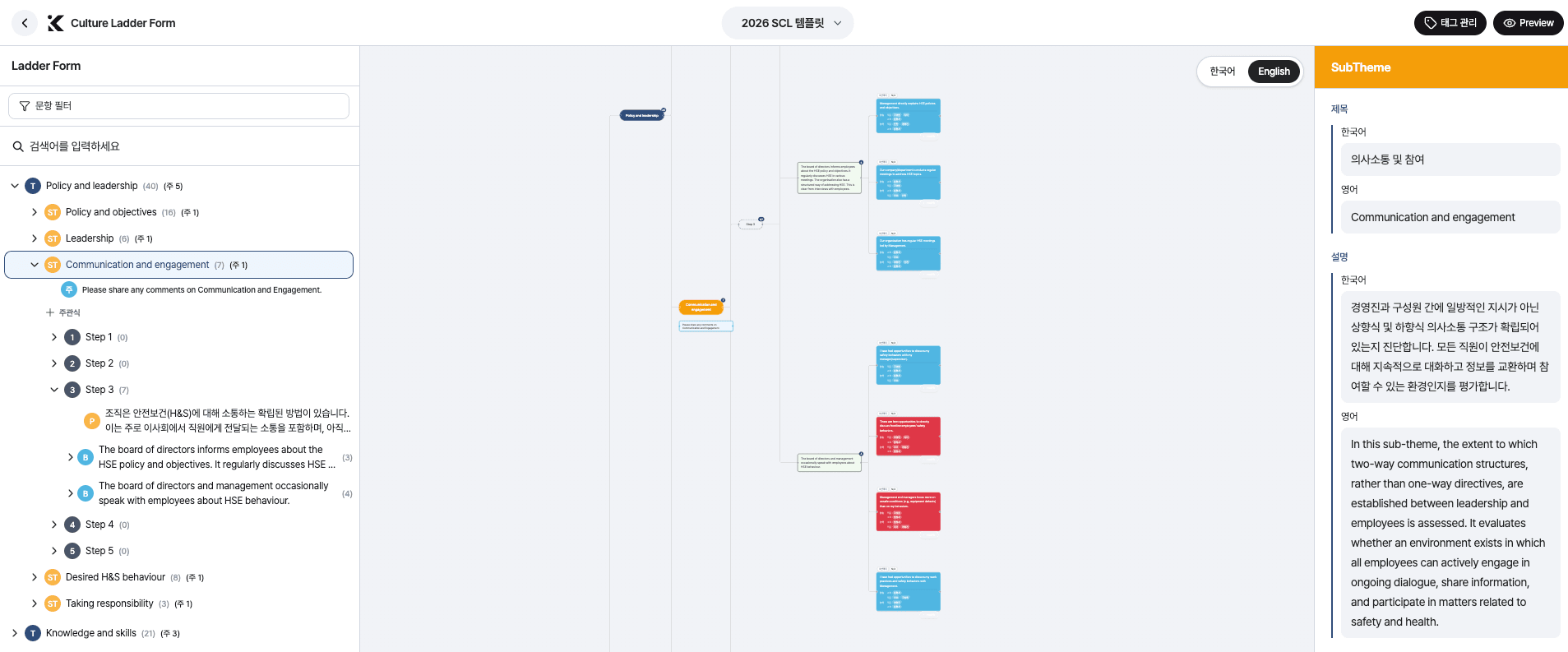
Cut Culture Ladder open and you see a four-tier hierarchy: Theme → SubTheme → Behavior → Question. The place that gets re-touched in each survey is, in fact, the bottom line — the question itself. To match the new risks a company faces — a new production line, a new contractor interface — the sentence of the question is adjusted every round. But the three tiers above where that question gets placed — Theme · SubTheme · Behavior — do not move between surveys. Or between companies.
Those three upper tiers are the benchmark. They are exactly the map we pinned in the previous part, and every Behavior carries which step it belongs to as a step value. For as long as Culture Ladder is live, the benchmark never changes between surveys. New risk surfaces, a new question is added — and that new question lands somewhere on top of the benchmark, but the benchmark itself doesn't shift.
If the yardstick moves with the company, it isn't measurement, it's grading. If it moves with the survey, it isn't measurement, it's marketing.
So the moment a survey closes, the system takes one more full snapshot of that survey's benchmark. Even if headquarters later edits the master map, this survey's results stay on the benchmark as it stood at that moment.
02 · The Target Rung
You don't give a fifth-grade exam to a first-grader
Give a first-grader a fifth-grader's exam and the score will be low. But if you look at that score and conclude “this child is bad at studying,” it isn't the measurement that's wrong — it's the reader of the measurement standing in the wrong place.
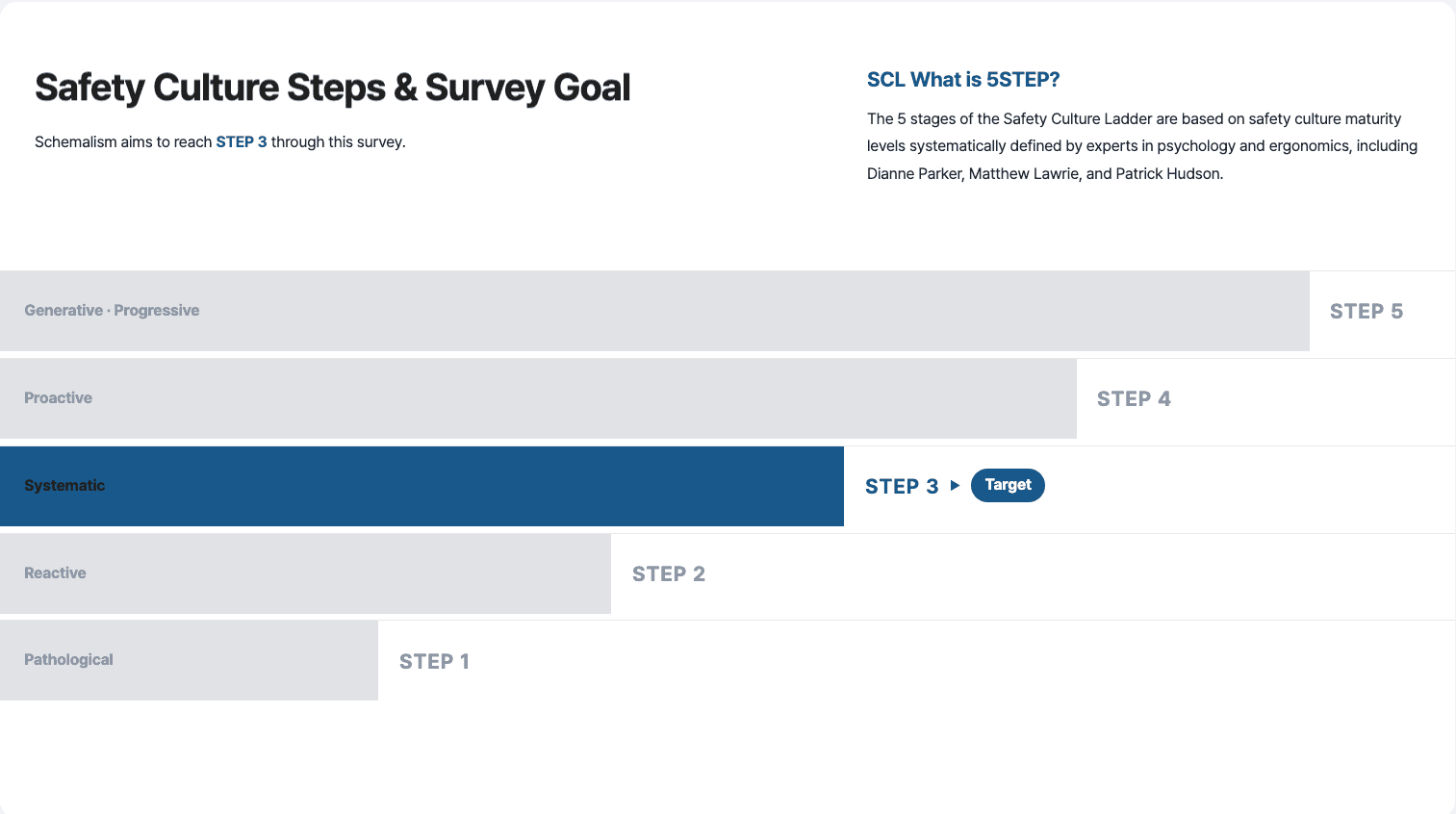
Companies are the same. A safety culture cannot climb every rung at once. Recall the NEN five rungs from part two: STEP 1 (Pathological) · STEP 2 (Reactive) · STEP 3 (Systematic) · STEP 4 (Proactive) · STEP 5 (Generative). Aim STEP 4–5 behavior questions at a company sitting on STEP 2 and the score is naturally low — and pushing the company because of that result is not what measurement is for.
So the benchmark is pinned step by step. Every behavior item knows, at design time, which step it belongs to; and every survey has its own target rung (target_step)— the rung the company is reaching for that round. First survey aims at STEP 3. Next survey, if STEP 3 cleared, aims at STEP 4. On the same survey form, only the target rung moves up one notch at a time. The fact that you don't have to climb the whole ladder at once is pinned not in the results screen but in the data structure.
The target rung freezes in the survey's metadata the moment the survey opens. So that nobody can say after the fact, “actually, we were aiming at STEP 4 this year” — it is set the moment the round opens and does not move from there.
03 · Round vs Round
Last year and this year on the same page
The weight is different when a hospital hands you a single health check-up sheet versus when it prints last year's numbers right next to this year's. Cholesterol 220 — if it was 240 last year, that single line changes the patient's next move. But most organizational-culture reports leave last year's sheet somewhere in a PDF folder, and this year's sheet lands on the meeting table as a single, standalone photograph.
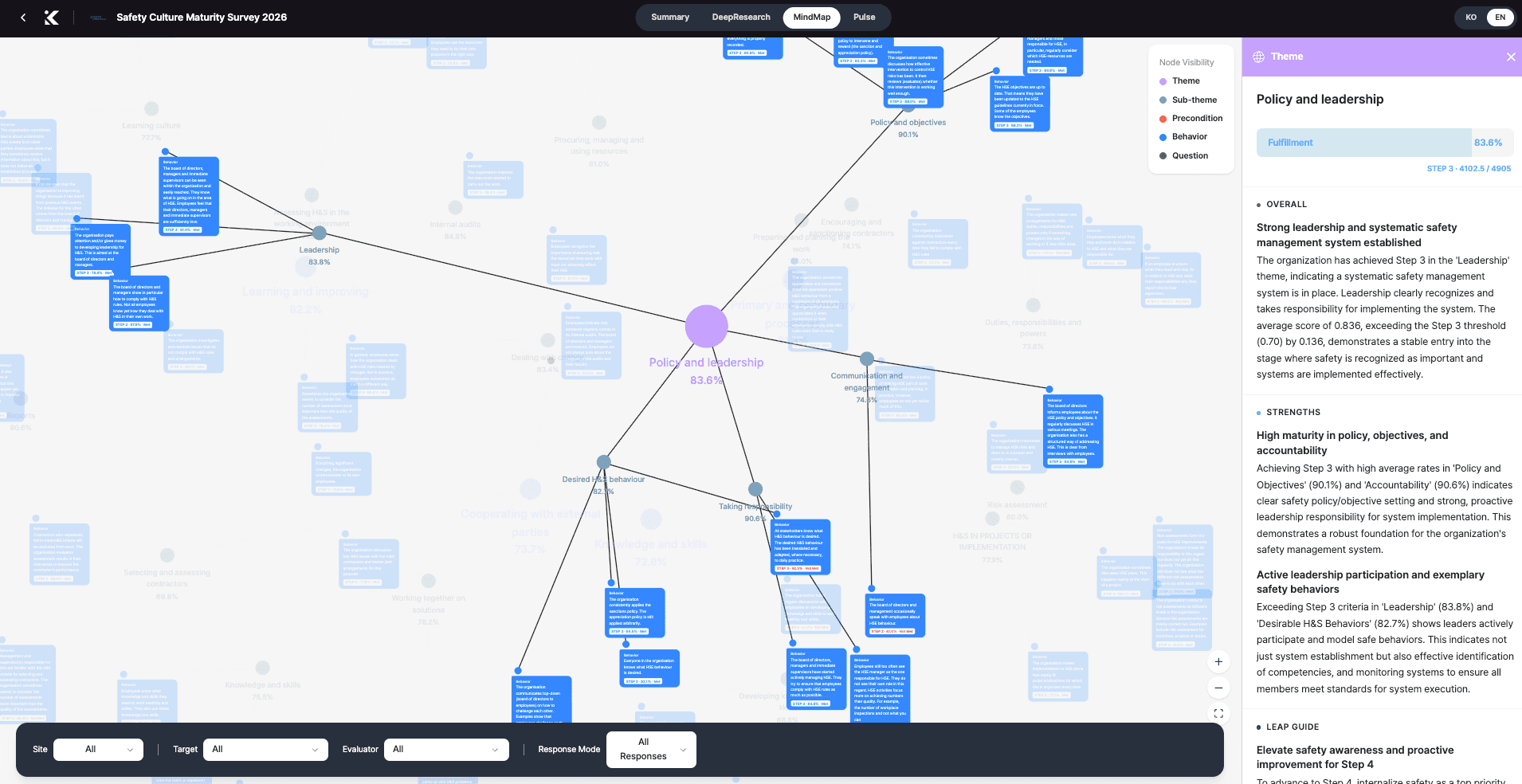
We made one decision at exactly this point in Culture Ladder: a company's results screen does not close as a single survey on its own. Because the promise of § 01 — the yardstick stays the same between rounds — is pinned in the system, two surveys' scores fall on the same point of the map. And once that's true, laying the two scores on the same screen is easy. At the Theme level, the SubTheme level, the individual Behavior level — where things rose, where things fell, all visible in one place.
A single round is a photograph. Surveys accumulate before they become a film.
If one survey is one photograph, three accumulated surveys let a company see itself from different points in time on its own timeline. First survey STEP 3 missed → second survey STEP 3 cleared → third survey aims at STEP 4. Same benchmark, same map, same step values. The company's movement is captured not as a single line of statistics but as a page of film.
04 · Within the Sector
The place of the percentile
Whether 80 on a high-school mock exam is a good score or a bad one only lands inside the distribution of everyone who took the same exam. Whether 80 is the 30th percentile or the 5th percentile is what sets the goal of the next exam.
Once a company starts having its own timeline, comparison with other companies on the same benchmark finally becomes possible. But not by pooling every company in one place. Lay an automotive-parts company and a general trading company on the same distribution and the meaning of the score breaks. The distribution has to be within an industry for one company's single point to carry meaning.
- Same benchmark.Because the map is identical across companies, comparison of scores doesn't break.
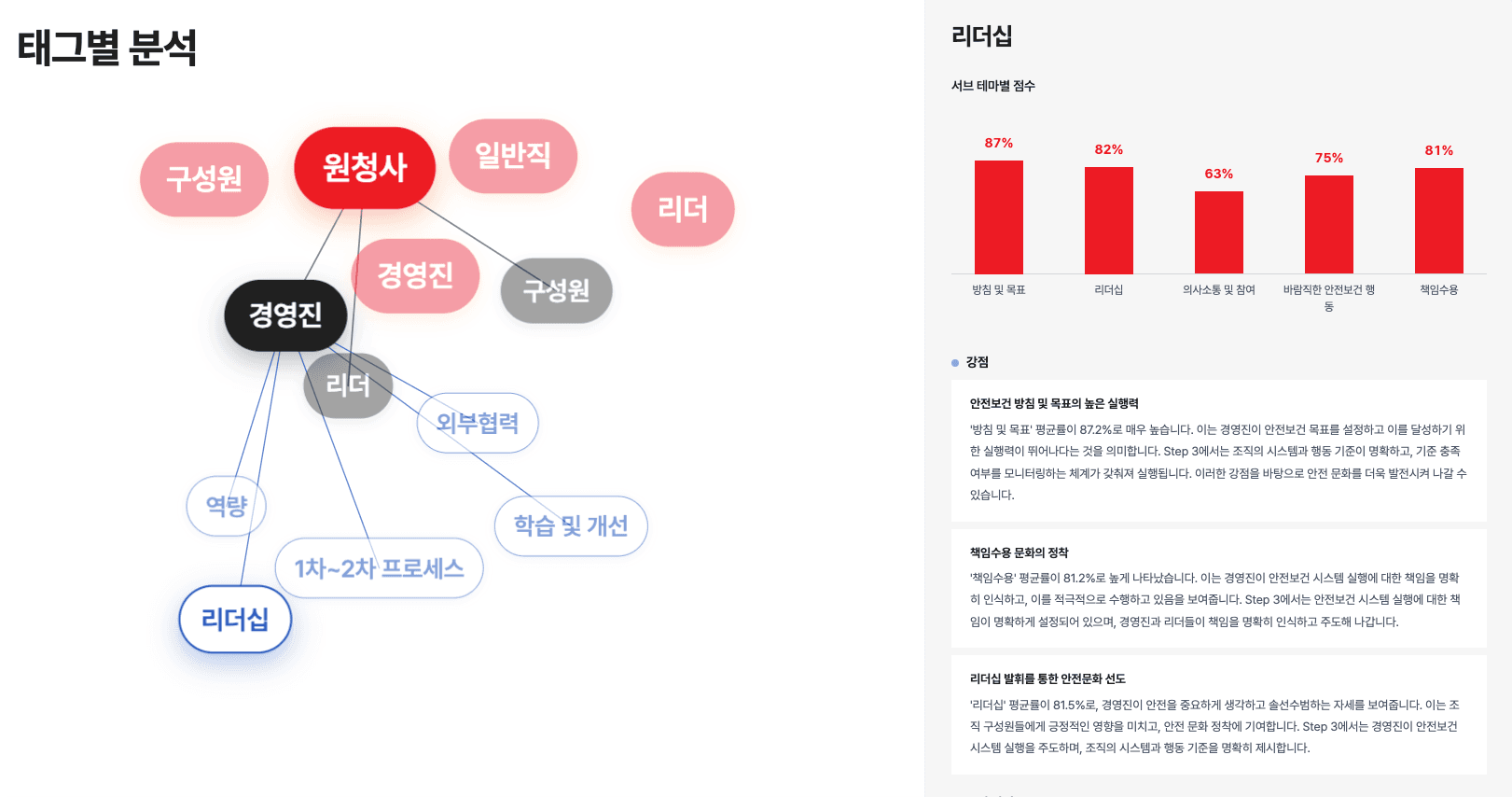
- Same units.Because the coordinates of site × respondent classification × analysis target share the same shape across companies, comparison doesn't stop at a single average line.
- Same survey cadence. Because the promise that the benchmark freezes per survey is shared between companies, an industry-wide timeline can finally be built.
Stand on top of that distribution and the meaning of “our company's STEP 3 attainment is 0.78” finally lands. Whether 0.78 is our industry's median, the top quartile, or the bottom quartile is what lets the next survey's target rung be set by where you stand in the distribution, not by gut feeling in the meeting room.
Speaking as someone who builds Culture Ladder while also taking it to market: selling a single survey to a single company isn't where Culture Ladder's real weight settles. That happens where companies in the same industry gather and a distribution forms. A newly joined company sees its place on the distribution from its very first survey. Once that place exists, one company's timeline connects into the industry's timeline.
The next two parts go one layer deeper inside that distribution: the conditions under which respondents can answer honestly, and the single place where AI organizes the accumulated responses — strictly inside the domain.
Written by

Yunhwan Jeong
Founder
Runs schemalism. Develops the business from an engineer's vantage — enjoys taking a hypothesis, validating it firsthand, and pushing it into the next bigger stage. Picks the next move every time at the seam where code meets business.
Part of this series
Can organizational culture actually be measured?
OpenKnock Culture Ladder is a survey-based diagnostic for organizational safety culture. The benchmark isn't ours. We lifted NEN SCL, the Dutch national safety-culture certification standard, and use its five-step ladder as is, asking which of the five rungs a company stands on, round after round, against the same benchmark. Built by schemalism with RIMS and LRQA, and already pinned in place on the same benchmark by Hyundai Mobis, Kumho Petrochemical, and POSCO International, ~15,000 responses in. Six essays on what we saw between measurement and change.
All parts
06

PART 01
Atmosphere isn't culture
PART 02
Five rungs from the standard
PART 03
The core
- You are here
PART 04
Rounds and benchmark
PART 05
AI inside the domain
PART 06
From measurement to change