We didn't build this ladder
OpenKnock Culture Ladder's five-step ladder isn't our invention. We lifted NEN's certifiable safety culture standard, the Dutch national standard, rung for rung, and built the program around it. A chapter that lays out where the yardstick came from, and what 'measuring against a standard, not a theory' actually weighs.

OpenKnock Culture Ladder's five-step ladder isn't something we built. The Dutch national standards body, NEN, settled those five rungs into a certifiable safety culture standard, and we lifted them, rung for rung, into the backbone of Culture Ladder.
Before we trace where the yardstick came from, place your own company in a single line.
The most recent time someone in your company reported a mistake. What happened to that person?
- Took a hit → STEP 1 · Pathological
- Nothing happened → STEP 2 · Reactive
- A new procedure was added → STEP 3 · Systematic
- Another team got checked for the same risk → STEP 4 · Proactive
- The person was publicly thanked → STEP 5 · Progressive
Most companies sit somewhere between STEP 2 and STEP 3. There's no shame in that. Open NEN's STEP 3 definition once more: “responsibility is clearly defined, standards for systems and behavior are explicit, and monitoring is set up and running against those standards.” Knowing where you stand is the first step toward STEP 4. Turning that knowing from a meeting-room consensus into an actual score begins with unfolding where the yardstick itself came from.
The roots run back to British safety psychologist Patrick Hudson, who through the 1990s and early 2000s shaped a safety culture maturity model on top of organizational sociologist Ron Westrum's typology of organizational cultures. Shell and Leiden University put it to work on the floor through the Hearts and Mindsprogram, safety training that treated a worker's heart and mind as the starting point of safe behavior. In 2012 the Dutch rail infrastructure operator ProRail hardened it into an assessment framework so it could measure itself and its contractors on the same yardstick. As of July 2016, NEN became the standard's steward, opening it to industries well beyond rail; the version in force today is SCL 2.0, live since January 2024. Culture Ladder's safety-culture diagnostic measures against those same five rungs. Not a yardstick we sanded down ourselves, but NEN's standard taken as is. Before we ask a company where it stands, we lay out where the yardstick came from. That's where Culture Ladder starts.
01 · The Ladder
NEN's five rungs, as is
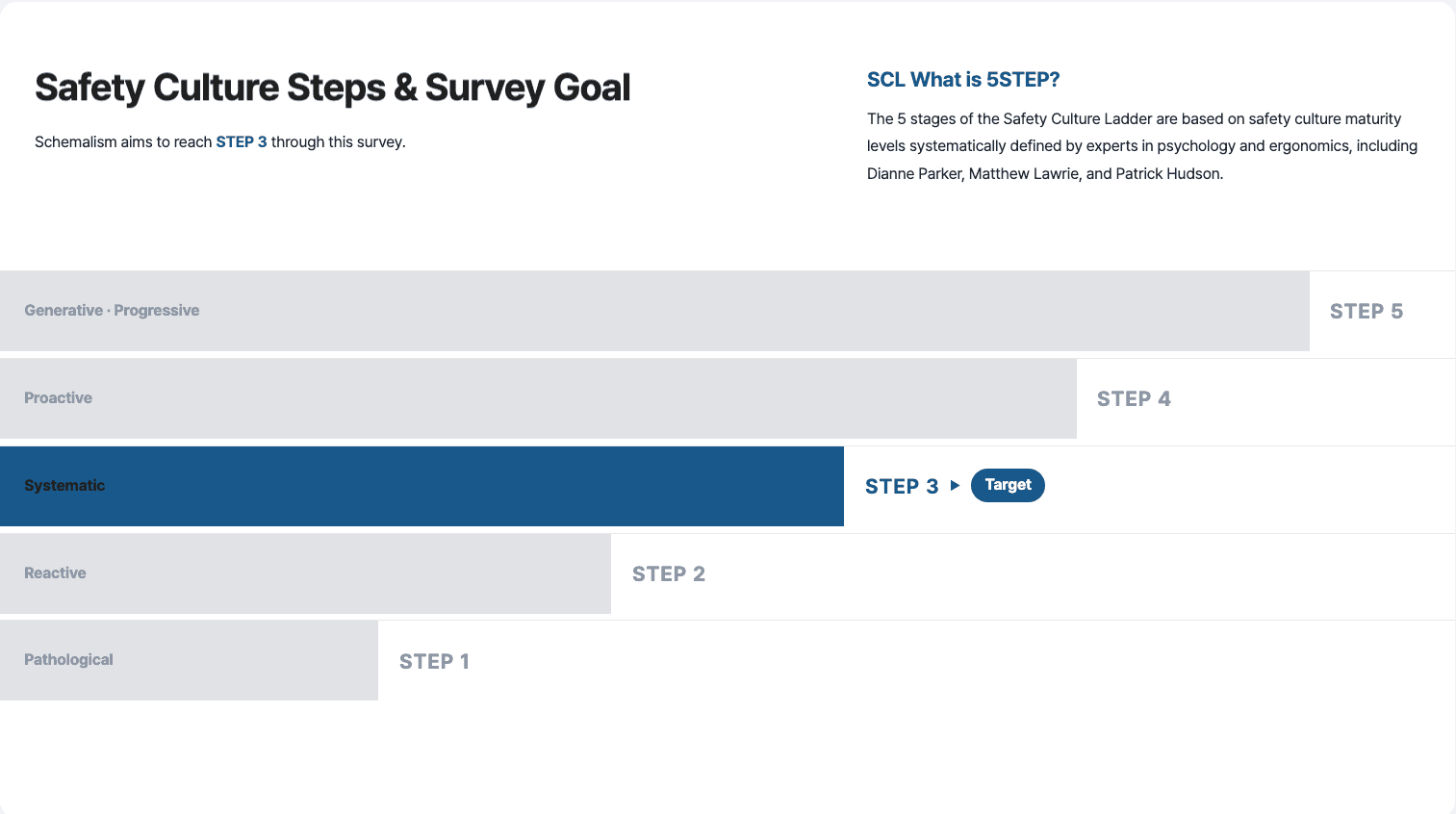
The visual below is lifted from the “survey objective” section of an actual Culture Ladder result screen. Tap any step and the definition written into NEN's certifiable standard unfolds on the spot. Culture Ladder is built not to hide its own ruler. The company being measured sees not only which rung it sits on, but what the rung itself demands.
Top to bottom: Progressive · Generative (STEP 5), Proactive (STEP 4), Systematic (STEP 3), Reactive (STEP 2), Pathological (STEP 1). Each rung is written in the language of observable behavior, so anyone, inside the company or outside, reads it the same way. That common meaning is the single strongest thing a certifiable standard gives you.
02 · What “certifiable” means
Where the standard actually grips
“Certifiable standard” is a phrase that often shows up in meeting rooms without much weight behind it. With NEN SCL the weight is specific. The audit process is exactly defined in people and hours, and the standard reaches well past the company's internal scorecards: it now sits as a clause in the procurement contracts that decide who gets the work.
- Audit structure. A company seeking certification is audited by a NEN-accredited third-party body (DEKRA · LRQA · Kiwa · TÜV NORD, among others). For STEP 3 and above, a two-person team (lead auditor plus auditor) walks through six aspects: leadership and involvement, policy and strategy, organization and contractors, workplace and procedures, communication, audits and statistics, through interviews and on-site observation. The structure is deliberately built to hear, in the same room, whether the answer from the executive floor matches the answer from the workplace.
- Three-year cycle.A certificate, once awarded, holds for three years; the year-2 and year-3 follow-up audits run at roughly 40% of the original audit hours. The standard's own skeleton refuses to let a single pass be the end of the story.
- Built into procurement.If you want to win a public works contract in the Netherlands, from June 2026 onward STEP 3 is the mandatory floor. The standard travels out of the safety team's self-check folder and onto the bid document itself. SCL has been written into Dutch construction tenders and contracts since January 2022, anchored in the industry-wide accord Veiligheid in Aanbestedingen (ViA).
Culture Ladder pins those same six aspects as the classification axes of its measurement and lays every round of results on the same five-rung yardstick. A certification audit is a thick, one-off photograph. You can't reshoot it every round. But on the same ruler, a series of lighter photographs taken often is what Culture Ladder can be: the same yardstick, more frequent reads.
A standard becomes a standard only when it doesn't end in the meeting room. NEN SCL sits on the bid document, and it doesn't fall off.
03 · Why NEN
Why NEN, of all of them
There are several safety-culture maturity models out there. The Bradley curve, DuPont's four stages, the PDCA cycle behind ISO 45001. Each one earns its place. Culture Ladder chose NEN SCL specifically, and there were three reasons for it.
- A certifiable standard. Inside and outside speak the same language.Had we held up a theory, every company would read it slightly differently. With NEN, an external auditor walks in carrying the exact same yardstick. The six audit aspects above sit right alongside the bones of an ISO 45001 OH&S management system, so a company that already runs ISO has a natural path to lay the language of safety culture over what it already has.
- Five rungs. Not too many, not too few. With three rungs, everyone clusters in the middle. With seven, the differences blur. Five is the smallest unit at which a company can honestly admit where it stands.
- Each rung is defined by behavior.Not abstractions like “high safety awareness,” but observable behaviors like “a hazard, once spotted, is reported upward” or “system and behavioral standards are explicit and monitored.” Only observable behavior is measurable.
Organizational culture rides on top of the safety ladder. The companies that measured safety first are the ones that come to see culture faster.
Culture Ladder's diagnostic isn't itself the NEN certification audit. It is the place where a company picks up the same yardstick and measures its own position, round after round. Not the one thick photograph of a certification audit, but a timeline of lighter photographs taken regularly against the same scale. That makes the sameness of the yardstick weigh more, not less. A company that has never been audited and one that already holds a certificate can both re-measure themselves on the same ruler, round after round.
Once you start from the fact that this ladder isn't our invention but NEN's standard, the rest of the questions in this series fall into line. How do you put an actual score on a company's rung, what does it take to keep a measurement round from going hollow, what do you look at in the places where averages lie, what has to be pinned in place for AI to be a real help in analysis, and how do you carry the measurement out of the PDF folder and into a cycle of change.
Written by

Yunhwan Jeong
Founder
Runs schemalism. Develops the business from an engineer's vantage — enjoys taking a hypothesis, validating it firsthand, and pushing it into the next bigger stage. Picks the next move every time at the seam where code meets business.
Part of this series
Can organizational culture actually be measured?
OpenKnock Culture Ladder is a survey-based diagnostic for organizational safety culture. The benchmark isn't ours. We lifted NEN SCL, the Dutch national safety-culture certification standard, and use its five-step ladder as is, asking which of the five rungs a company stands on, round after round, against the same benchmark. Built by schemalism with RIMS and LRQA, and already pinned in place on the same benchmark by Hyundai Mobis, Kumho Petrochemical, and POSCO International, ~15,000 responses in. Six essays on what we saw between measurement and change.
All parts
06

PART 01
Atmosphere isn't culture
- You are here
PART 02
Five rungs from the standard
PART 03
The core
PART 04
Rounds and benchmark
PART 05
AI inside the domain
PART 06
From measurement to change